

Key Insights: Monograph initiation
Published 16 June 2026
In this month’s Key Insights, we explore how the British Pharmacopoeia Commission (BPC) decides when to develop a new monograph or revise an existing one. This work helps ensure that public quality standards continue to support safe and effective medicines.
We will cover:
- the mechanism by which monographs are selected and developed
- the criteria BPC uses to prioritise monograph development work
- what happens following initiation
- examples of how criteria are applied to current initiated work
- how users can suggest new monographs or revisions to existing monographs
Monograph development: mechanism
Supplementary Chapter III B* of the British Pharmacopoeia (BP) outlines general situations under which the BPC will consider the development of a monograph.
A monograph for the drug substance used in a product is a pre-requisite for a product monograph to be developed by the BPC.
*An active licence for the BP Online is required to view this link.
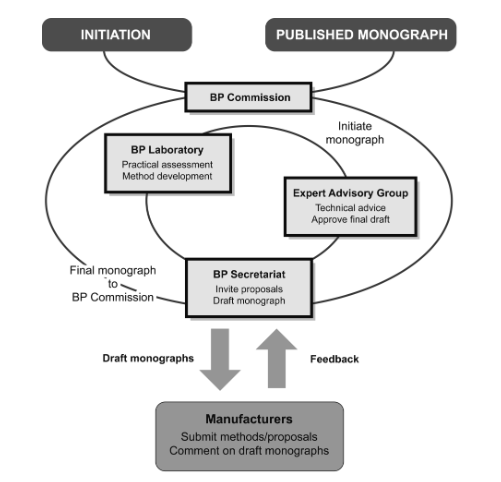
The diagram above provides a simplified, schematic representation of the development of a monograph for a medicinal substance or an associated formulated preparation.
Prioritising BPC work: criteria
By developing and publishing new monographs for medicines and medicinal products, the BP provides publicly available quality standards that support public health. New monographs can help address gaps where a recognised public standard is needed, while revisions help ensure existing standards remain current, practical and fit for purpose.
Users may wish to propose a revision to an existing BP monograph for a range of reasons – for example, if a reagent is no longer readily available, if a method could be made more efficient, or if an update could help reduce environmental impact.
For its work on both new and revised monographs, BPC prioritises work using criteria based on usage and clinical need.
The type of data used by the BPC includes:
- Prescription Cost Analysis - an accredited source of the number of items of all prescriptions dispensed in the community in England
- WHO Model Lists of Essential Medicines - First published in 1977; the WHO Essential Medicines list is updated every two years by the Expert Committee on Selection and Use of Essential Medicines
Examples
The prioritisation criteria can be seen on current public consultation window (April to June 2026).
Lidocaine Injection – This medicine is used in urgent and critical care, including during cardiac arrest and after heart attacks, where reliable quality standards are especially important. This medicine is listed in the WHO Model List of Essential Medicines. The BP are currently conducting a significant revision to this monograph, reflecting the wide usage and clinical need for a strong public standard.
Nitrazepam Tablets and Nitrazepam Oral Suspension – These established monographs continue to provide quality standards for medicines used in the short-term treatment of insomnia. Given the ongoing usage of these medicines, it is important to maintain up-to-date standards. The BP are currently responding to our users by revising these well used monographs to ensure that they reflect current technical expectations.
Request work on a monograph
Users can ask the British Pharmacopoeia Commission to consider developing a new monograph or revise an existing one.
If you would like to suggest new work, please share the key product, specification, method, validation, impurity and stability information with us at bpcom@mhra.gov.uk.
You can learn how to contribute to monograph development and improvement, and view full guidance on the information required through the button below. 
As with all requests, prioritisation will be guided by the criteria of usage and clinical need.