

Key Insights: Focus on chromatography
In this month’s Key Insights, we will focus on chromatography in the British Pharmacopoeia (BP) and some of the system suitability test (SST) requirements, which can be found in the chapter on “Chromatographic Separation Techniques”.
We will cover:
- System suitability requirements of CST
- Peak symmetry
- System sensitivity

Illustration of a chromatogram.
Three considerations for system suitability tests in Chromatographic Separation Techniques
Before chromatographic results can be trusted, system suitability tests are used to confirm that the analytical system is performing as expected.
Information relating to SSTs can be found in the BP, in Appendix III “Chromatographic Separation Techniques” (or CST), which is largely made up of a full reproduction of Ph. Eur. chapter 2.2.46.
This is a chapter which has undergone pharmacopoeial harmonisation, so be aware of the text between the white diamond symbols (♢) which indicates the local (Ph. Eur./BP) requirements.
1. Some system suitability requirements apply even if not mentioned in a monograph.
The BP receives questions about what SSTs should be applied if none are mentioned specifically in a monograph. The answer can be found in the CST appendix. The chapter states that:
'The following requirements are to be fulfilled, in addition to any other system suitability criteria stated in the monograph.'
In practice, this means that the SSTs of CST apply even if there are no SST requirements mentioned in a pharmacopoeial monograph.
For liquid chromatography and gas chromatography, these are:
System sensitivity (signal-to-noise ratio)
Peak symmetry (tailing factor)
System repeatability (relative standard deviation)
In addition for BP formulated preparation monographs, unless otherwise stated, a requirement exists that the maximum permitted relative standard deviation (RSD) for six replicate injections of the prescribed reference solution does not exceed 2.0%.
2. Peak symmetry applies to peaks used for quantitation.
The CST peak symmetry requirement applies to the peak(s) used for the quantitation in any LC or GC test or assay.
This may include:
a principal peak in a reference solution made up of a diluted sample;
a peak due to a specific impurity used for quantitative purposes.
The symmetry factor requirement of 0.8-1.8 is stated in CST and this would be superseded by any specific symmetry factor requirement in a monograph.
3. There are reasons the BP may apply specific sensitivity requirements to meet the requirements of CST.
Where no specific requirements are stated in a monograph, the requirements of CST still need to be fulfilled and this appendix states that:
‘The signal-to-noise ratio is used to define the system sensitivity. The limit of quantitation (corresponding to a signal-to-noise ratio of 10) is equal to or less than the reporting threshold.’
BP monographs may include specific and distinct requirements to ensure this condition is met. A common reason to include one is the use of correction factors greater than 1. If a correction factor of greater than 1 is applied to a secondary peak, it indicates that the peak under-responds relative to the reference peak. In these situations, the requirements for the signal-to-noise ratio in the BP will increase to reflect this under response.
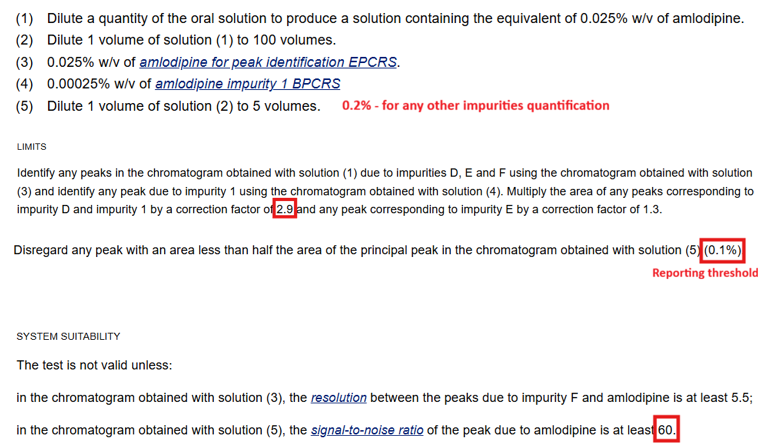
A good example of this can be seen in the Related substances test of the BP 2026 monograph for Amlodipine Oral Solution. The threshold required in the monograph is 0.1%, however, the concentration of the reference solution (5) used to check the sensitivity of the method is 0.2%, therefore, the requirement for the signal-to-noise ratio is increased to 20 (10 x 2).
Furthermore, the correction factor for impurity 1, which is supposed to be controlled against the diluted sample solution (5), is 2.9, so the previous signal-to-noise ratio requirements should be multiplied by 3, which results in the final signal-to-noise ratio requirement of 60.
More information about how to interpret a BP formulated preparation monograph can be found in our 'How to use the BP' guide.