

Key Insights: The British Pharmacopoeia Commission
Published 10 September 2026
In this month's Key Insights, we're lifting the lid on the public body at the heart of the British Pharmacopoeia (BP): the British Pharmacopoeia Commission (BPC).
We'll cover:
- what the BPC is and why it exists
- where it sits within the UK regulatory landscape
- who its members are
- how it operates
- our new BPC Observer scheme
What is the British Pharmacopoeia Commission?
The British Pharmacopoeia Commission (BPC) is the statutory body responsible for overseeing the development and maintenance of the British Pharmacopoeia, the official collection of quality standards for medicines and pharmaceutical substances in the UK. The Commission operates under the Human Medicines Regulations 2012.
The Commission remains an Advisory Non-Departmental Public Body because its work requires independence from the regulator. The 2014 triennial review concluded that this independence was important to ensure standards are developed objectively and remain appropriate for industry and the wider healthcare system.
Its responsibilities include:
- preparing and maintaining the British Pharmacopoeia and British Pharmacopoeia (Veterinary)
- selecting and publishing British Approved Names (BANs)
- providing policy and technical advice on BP standards
- advising the UK delegation to the European Pharmacopoeia Commission
- appointing members to Expert Advisory Groups (EAGs), panels and working parties
Who are the Commissioners?
The Commission brings together experts from across pharmaceutical science, healthcare, academia, industry and patient representation. Members are appointed by the Department of Health and Social Care (DHSC) on behalf of Ministers and contribute their expertise to help ensure that BP standards remain scientifically robust and relevant.
The Commission currently comprises 19 Commissioners, including a Chair, Vice-Chair, scientific experts and lay members.
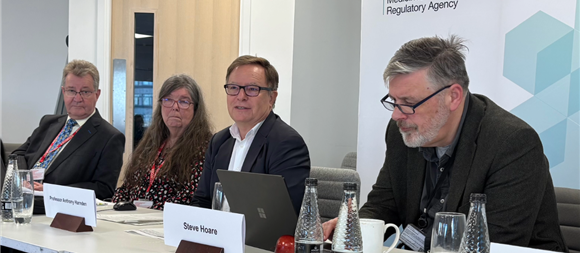
(Left to right) Rob Lowe (Vice-Chair of the BP Commission), Anna-Maria Brady (Chair of the BP Commission), Professor Anthony Harnden (Chair of the MHRA, Guest), and Steve Hoare (Secretary and Scientific Director of the BP Commission).
How does the Commission work?
The BPC typically meets three times each year to review the progress of EAGs, to review technical proposals, consider strategic priorities and oversee the policies that underpin BP development. Summary minutes of Commission meetings are published on the BP website, providing transparency of decision-making.
While much of the detailed scientific work is undertaken by the BP's network of EAGs and specialist working parties, the Commission provides oversight and direction, ensuring that standards continue to support the quality, safety and efficacy of medicines used in the UK and around the world.
Opening the doors: the BPC Observer Scheme
As part of our commitment to greater transparency and engagement, we have recently piloted a British Pharmacopoeia Commission Observer scheme.
The scheme enables individuals who are not Commission members to attend BPC meetings as observers, subject to an appropriate screening and approval process. The pilot has provided valuable insights and positive feedback from participants, helping to broaden understanding of how Commission decisions are made and how BP standards are developed.
Following the success of the pilot, we are now planning to expand the Observer scheme, creating further opportunities for interested stakeholders to gain first-hand insight into the work of the Commission.
If you are interested in an observer place, sign up for email updates from the BP and you will receive an email when the expression of interest form opens in October.
By opening up elements of the Commission's work, we hope to strengthen engagement with the BP community and provide greater visibility of the people, processes and expertise behind the standards that support medicines quality.