

Key Insights: Understanding the relationship between the BP and the Ph. Eur.
Published 24 September 2026
In this month’s Key Insights, we will be discussing how the European Pharmacopoeia (Ph. Eur.) and British Pharmacopoeia (BP) work together, and the role the BP plays in the development of the Ph. Eur.
We'll cover:
- the distinction between BP and Ph. Eur. content
- the role of the UK and BP at the European Pharmacopoeia Commission
- how users of the BP benefit
- collaboration beyond Europe
The British Pharmacopoeia is an internationally facing compendium
The British Pharmacopoeia, established in 1864, is used in over 100 countries and is one of many Pharmacopoeias that exist around the world1.
Whichever country a pharmacopoeia originates from, a common objective of a pharmacopoeia is to contribute to the protection of public health through the development of common standards for the quality of pharmaceutical substances and medicinal products.
One of the most important international relationships for any user of the British Pharmacopoeia is the relationship between the British Pharmacopoeia and the European Pharmacopoeia2.
1
Index of World Pharmacopoeias and Pharmacopoeial authorities
2
European Pharmacopoeia Online
The European Pharmacopoeia
The European Pharmacopoeia (often referred to as the Ph. Eur.) is published by the European Directorate for the Quality of Medicines (EDQM). The EDQM is part of the Council of Europe and the Ph. Eur.’s legal basis is the Convention on the Elaboration of a European Pharmacopoeia, signed in Strasbourg 1964.
The European Pharmacopoeia is legally binding in 39 member states, including the United Kingdom.
The European Pharmacopoeia contains over 3,000 monographs all of which are reproduced in the BP for the convenience of our users.
The UK's role in the elaboration of the European Pharmacopoeia: National Pharmacopoeia Authority
In each member state, a national authority is responsible for participation in the European Pharmacopoeia. In the UK, this role is performed by the British Pharmacopoeia. As the UK's National Pharmacopoeia Authority (NPA), the BP coordinates UK comments on draft texts during PharmEuropa consultations, nominates UK representative experts to European working groups and supports the UK Delegation (UKD) in representing the UK within the European Pharmacopoeia Commission.
For the latest details about who provides the UK input to the European Pharmacopoeia you can read Supplementary Chapter IV A. Membership of the European Pharmacopoeia Commission.*
*You will need an active licence to the BP to access this information.
The Council of Europe
A common misconception is that the European Pharmacopoeia is a European Union (EU) publication. In fact, it is the Council of Europe that develops the Ph. Eur. under the European Directorate for the Quality of Medicines (EDQM) through the European Pharmacopoeia Convention.
The Council of Europe is separate from the European Union. The UK is a founding member of the European Pharmacopoeia Convention and continues to participate widely in the development and adoption of European Pharmacopoeia standards through its role as the UK’s NPA.
What the European Pharmacopoeia means for BP users
Both British and European Pharmacopoeia standards have legal status in the UK3.
The BP contains all the standards needed to demonstrate that a pharmaceutical substance or medicinal product marketed in the UK is compliant.
This means the BP includes:
- national British Pharmacopoeia monographs
- all European Pharmacopoeia texts
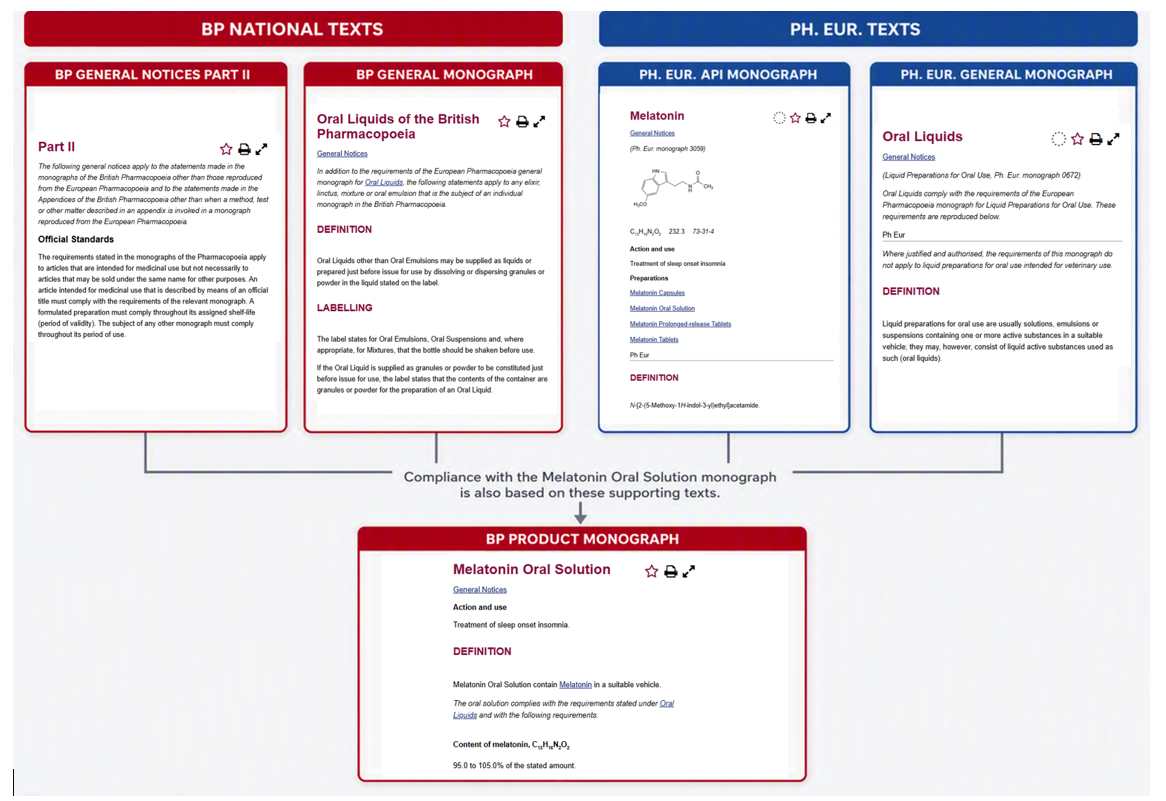
European texts are highlighted in the BP with what is known as a “chaplet of stars”, as seen in the example below.

The national monographs of the BP and the content of the Ph. Eur. work in harmony with each other and you’ll find the BP formulated product monographs very often refer to Ph. Eur. monographs for the active ingredient.
The following example shows how the BP 2027 edition national British Pharmacopoeia monograph for Melatonin Oral Solution refers to:
- the General Notices Part II (a national BP text)
- the additional requirements of the general monograph for Oral Liquids of the British Pharmacopoeia
- the Melatonin API monograph (a monograph of the Ph. Eur.)
- the general monograph for Oral Liquids (a monograph of the Ph. Eur.)
3 The Human Medicines Regulations 2012
Collaboration beyond Europe
As well as our important relationship with the Ph. Eur., the BP works with other international organisations and institutions including the World Health Organisation (WHO), the United States Pharmacopeia (USP) and the Indian Pharmacopoeia to name just three.
The relationship between the BP and the Ph. Eur. is central to how pharmacopoeial standards are published in the UK. By reproducing Ph. Eur. texts alongside national BP monographs, the BP provides users with a single, practical source for the standards needed to support the quality of medicines in the UK and across many international markets.
The BP’s role as the UK’s NPA also ensures that UK expertise contributes to the development of European standards, while the BP’s wider international engagements and collaborations help support consistency, transparency and confidence in medicines quality beyond Europe.
For BP users, this means access to a publication that is both nationally authoritative and internationally connected, bringing together the standards needed which support the protection of public health by providing quality standards.